CSA Cyber Essentials vs Cyber Trust Mark: Which Certification Does Your Singapore Business Need?
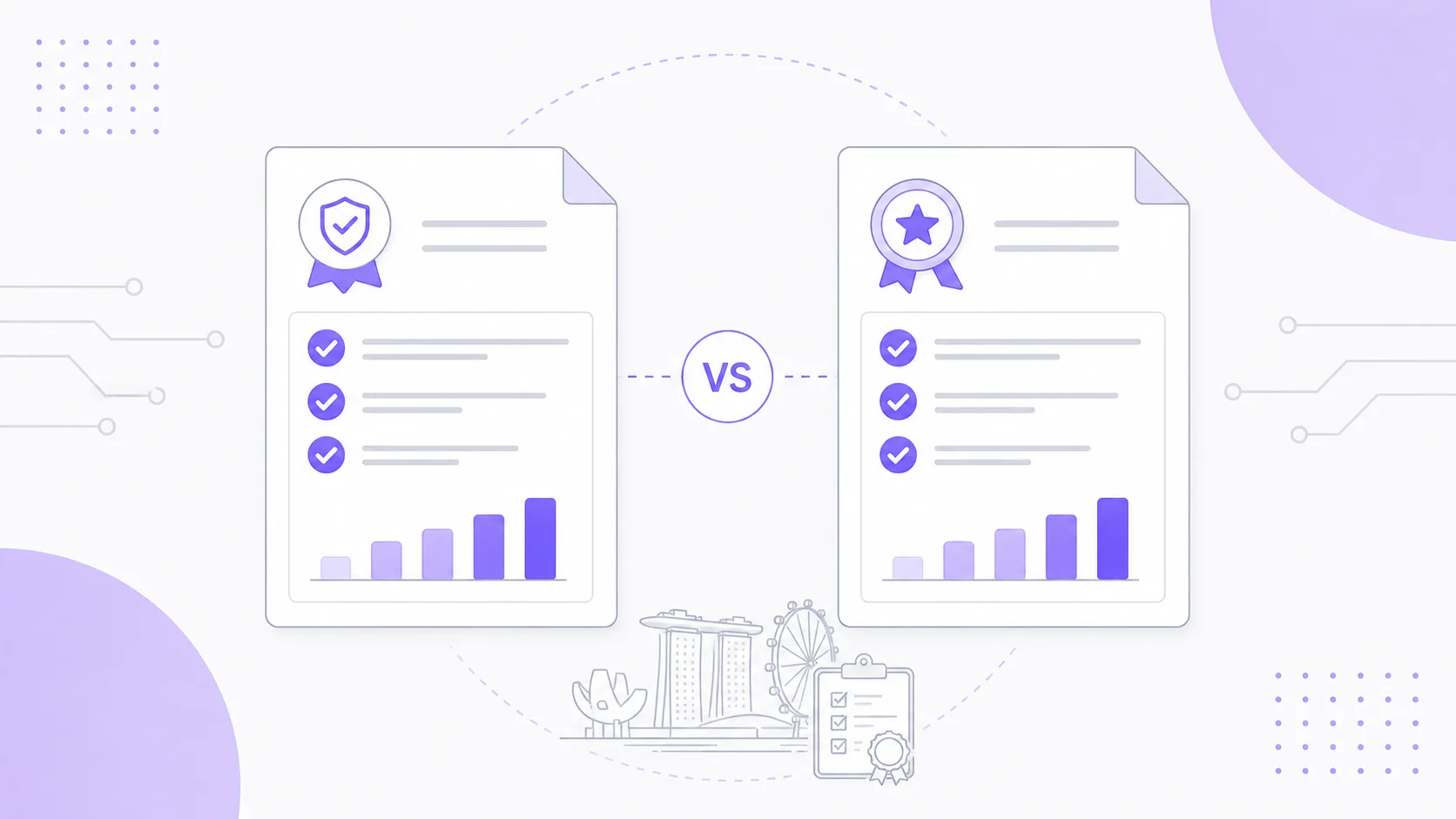
The Cyber Security Agency of Singapore operates two cybersecurity certification programmes for businesses: Cyber Essentials and Cyber Trust Mark. Both were updated in 2025 with revised requirements. Both carry the CSA endorsement and are increasingly referenced in government procurement requirements and enterprise supplier questionnaires.
Many Singapore business owners and IT managers know these certifications exist but are uncertain which one is right for their organisation, whether they need both, and what achieving either actually involves. This guide answers those questions.
The Short Answer
Cyber Essentials is designed for SMEs with a relatively straightforward IT environment. It focuses on foundational controls and is achievable within weeks for organisations with basic IT hygiene already in place.
Cyber Trust Mark is designed for organisations with more significant digital operations. It requires a broader and deeper set of controls, a formal audit process, and governance capability that goes well beyond what Cyber Essentials asks for. It is positioned as the benchmark for organisations that handle sensitive data, serve enterprise customers, or operate in sectors with elevated cyber risk.
If you are an SME with a standard IT setup and no immediate requirement to demonstrate advanced security capability to customers or regulators, Cyber Essentials is the right starting point. If you manage sensitive data, have enterprise customers who ask about your security posture, or are planning to pursue ISO 27001 or SOC 2 internationally, Cyber Trust Mark is the more appropriate target.
Cyber Essentials: What It Covers and What Changed in 2025
Cyber Essentials is CSA's entry-level certification. It targets organisations that may not have a dedicated IT security function and focuses on the controls that address the most common attack vectors affecting Singapore SMEs.
The 2025 update is organised around five control areas. Asset and software management covers maintaining an inventory of devices and software, ensuring only authorised software is installed, and removing software that is no longer supported. The 2025 version places greater emphasis on cloud assets and SaaS applications, reflecting where most SME data now lives.
Secure configuration requires that devices and systems are set up securely from the start, with default passwords changed, unnecessary services disabled, and secure protocols enforced. The update extends baseline configuration requirements to cloud environments, which were largely absent from the previous version.
Software updates addresses applying security patches within defined timeframes. The 2025 standard tightens the required patching windows for critical vulnerabilities, responding to the reality that unpatched systems remain one of the most exploited attack vectors in Singapore.
Access control requires implementing least privilege, using multi-factor authentication for remote access and privileged accounts, and maintaining a process for removing access when it is no longer needed. MFA requirements were expanded in the 2025 update to cover a broader range of access scenarios, reflecting how much more access is now cloud-mediated rather than on-premise.
Malware protection covers deploying and maintaining protection on devices and having a defined process for responding to detections. The 2025 update acknowledges that traditional antivirus is insufficient for many current threats and requires organisations to demonstrate awareness of the limitations of their chosen controls.
The assessment itself is a self-assessment questionnaire reviewed by a CSA-approved assessor. There is no on-site audit. The assessor reviews your responses, may request supporting evidence, and certifies compliance if the requirements are met. For organisations with basic IT hygiene already in place, the process from starting to receiving the certificate typically takes four to eight weeks. The assessment fee runs between SGD 500 and SGD 2,000, and the certificate is valid for two years.
Cyber Trust Mark: What It Covers and What Changed in 2025
Cyber Trust Mark is CSA's advanced certification. It is built for organisations with more complex digital operations and assesses security capability across a broader range of domains.
The 2025 update reorganised the assessment framework and introduced more explicit requirements around cloud security, software supply chain risk, and operational technology. The domains covered include governance and risk management, which requires evidence of board-level engagement with cybersecurity risk and a defined risk management process. Asset management requires a comprehensive inventory covering cloud resources, data flows, and third-party systems. Access management assesses identity and access controls including privileged access management, MFA across all systems, and defined access review processes.
Security operations addresses detection and response capability, covering logging, monitoring, incident response plans, and evidence that those plans have been tested. Supply chain and third-party risk requires documented due diligence processes for vendors and contractual security requirements. Resilience and recovery covers business continuity planning specific to cybersecurity scenarios, with defined recovery objectives and testing evidence. Vulnerability management requires a defined process for identifying and remediating vulnerabilities, including regular scanning and penetration testing.
Unlike Cyber Essentials, Cyber Trust Mark requires a formal audit conducted by a CSA-approved certification body. The process involves document review, interviews with key personnel, and technical verification of controls. Organisations that have already completed ISO 27001 will find significant overlap in the evidence required, and for many companies it makes sense to pursue both frameworks together rather than sequentially.
The assessment cost typically ranges from SGD 8,000 to SGD 25,000, with additional internal costs for preparation and any remediation work. The timeline from beginning preparation to receiving the certificate is three to nine months, depending on current security maturity. The certificate is valid for two years.
How to Choose Between Them
The decision is mostly straightforward once you are honest about your current state and your near-term objectives.
Cyber Essentials is the right choice if your organisation has fewer than 50 employees and a standard IT environment, primarily using SaaS tools and standard endpoints. It is also appropriate if you need a recognised security certification for a tender or procurement requirement but do not yet have the maturity or resources for Cyber Trust Mark, or if you want to use it as a stepping stone toward a more advanced certification later.
Cyber Trust Mark is the right choice if your business handles sensitive personal or financial data in volume, if enterprise customers reference CSA certification in their vendor requirements, if you operate in or serve regulated sectors such as financial services or healthcare, or if you are planning to pursue ISO 27001 or SOC 2 and want to build a programme that satisfies multiple frameworks simultaneously.
One question worth asking directly is whether you can skip Cyber Essentials and go straight to Cyber Trust Mark. For most organisations, the answer is yes. Cyber Trust Mark covers all the Cyber Essentials control domains and more. Organisations that achieve Cyber Trust Mark have implicitly met Cyber Essentials requirements. If your target is Cyber Trust Mark, there is no need to pursue both.
Does CSA Provide Funding?
Yes. CSA provides co-funding for both certifications through the SG Cyber Safe Enterprises scheme. Eligible SMEs can receive financial support for assessment costs. The eligibility criteria follow standard SME definitions: registered in Singapore, at least 30% local shareholding, and either annual turnover not exceeding SGD 100 million or fewer than 200 employees. Applications are submitted through the Business Grants Portal and must be approved before the certification engagement begins. Retrospective applications are not accepted.
How These Certifications Fit With ISO 27001 and SOC 2
Cyber Essentials and Cyber Trust Mark are Singapore-specific certifications. They sit alongside international frameworks rather than above or below them.
The most common question is how Cyber Trust Mark relates to ISO 27001. There is significant overlap in their control requirements, and the evidence produced for Cyber Trust Mark is largely reusable in an ISO 27001 programme. Organisations that need both Singapore market credibility and international certification recognition should structure their security programme to serve both assessments rather than treating them as separate workstreams. Most certification bodies that handle Cyber Trust Mark also have ISO 27001 capability, and a joint programme is typically more efficient than two sequential ones.
Getting Started
The most common mistake organisations make is waiting until a customer or procurement requirement creates urgency. Certification programmes take time to prepare for, and starting under deadline pressure typically increases cost and reduces the quality of the outcome.
A gap assessment against the requirements of your target certification is the most useful starting point. It identifies what is already in place, what needs to be built or improved, and what a realistic preparation timeline looks like given your current state.
How Palisade Can Help
Palisade supports Singapore businesses preparing for Cyber Essentials, Cyber Trust Mark, ISO 27001, and SOC 2 certification through gap assessments, remediation planning, policy development, and audit preparation.
We work with organisations at different starting points, from those building their first security documentation to those with mature programmes looking to add a new certification.
See how we scope security consulting engagements, or book a free consultation to discuss your certification goals.